


“Writing as writing. Writing as rioting. Writing as righting. On the best days, all three.”
Teju Cole
The College Writing Program
The College Writing Program (CWP) has the distinction of serving nearly every undergraduate student at Buffalo State University. We provide the introductory writing courses to meet SUNY’s General Education Communication requirements at our university and support students for writing in academic and public spaces. Our program’s teaching practices reflect our commitment to supporting students’ writerly development and holistic well being as learners, adults, and engaged community members.
We are happily housed inside BSU's English Department.
Check Out What's New With Us
Title II Professional Development: CWP's Accessibility Workshop
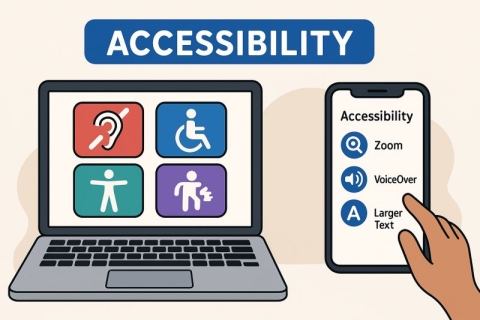
*image depicts laptop and phone with accessibility icons*
Pedagogical Refresh Symposium: CWP Presentation
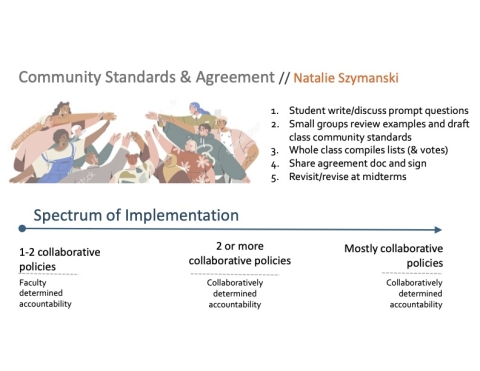
On January 16, 2026, CWP Director (Natalie Szymanski) was invited to present the Writing Program's pedagogical best practice of creating collaborative "Community Standards" at the Deans' Pedagogical Refresh Symposium.
This community-based approach works to proactively manage and reinforce classroom expectations through the collaborative creation of a community agreement. Founded in social and restorative justice theory, this practice encourages faculty to offer students a range of prompts concerning classroom behavior or course policies; facilitate discussion and drafting of standards for the class community to follow; and compile and revise a shared document to be signed by all members of the course. Faculty and students can then revisit (and revise) this agreement as needed throughout the semester.
Those looking to explore the implementation of such a strategy can find Dr. Szymanski's slides and past example of CWP students' community agreements.
This presentation was yet another way the College Writing Program works to contribute to the pedagogical growth and evolution of General Education courses at Buffalo State.
*image depicts process for creating community standards and the spectrum of implementation slide linked above*
CWP Student Responsibility and AI Usage Policy
In 2025, the College Writing Program faculty met on several occasions to discuss AI usage in college writing courses. In committee and larger cohort meetings, we explored national and disciplinary best practices regarding first-year writing and students' understanding and use of AI programs when brainstorming, researching, and drafting. Most specifically we turned to the MLA-CCCC Joint Task Force on Writing and AI and 2023 and 2024 working papers: Overview of the Issues, Statement of Principles, and Recommendations; Guidance from the MLA-CCCC Task Force; Building a Culture for Generative AI Literacy in College Language, Literature, and Writing.
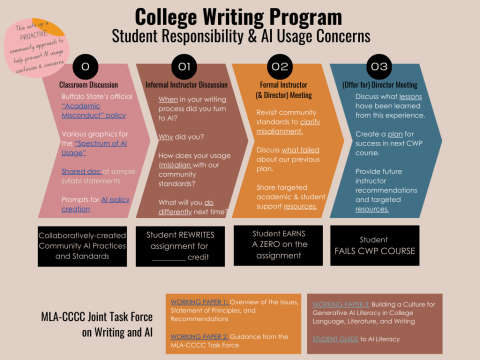
In order to cultivate a writing culture that uses PROACTIVE, community approaches to help prevent AI usage confusion and concerns, we collaboratively created and piloted the use of our own 4 step AI policy.
FIRST, CWP faculty begin each semester with writing prompts and discussion about Buffalo State's official "Academic misconduct" policy; the wide spectrum of different uses of AI in writing; and sample syllabi statements from an array of courses regarding the inclusion or exclusion of AI. Faculty then use those discussions as the basis for a community created AI agreement; together as a classroom of writers they create their own expectations, boundaries, and measures of accountability.
NEXT, if a faculty member feels a student has submitted work that violated their class's AI agreement, they meet with the student informally to discuss when in the writing process s/he turned to AI; why s/he did; how her/his usage (mis)align with the community standards; and what will s/he will do differently next time. Student are then afforded the opportunity to resubmit the assignment for reduced credit. This intervention step allows faculty and students to (re)align expectations and students to receive formative, non-punitive feedback when AI and been misused.
LASTLY, if the student violates the community agreement a second time, s/he is required to meet with the program Director to revisit community standards to clarify misalignment; discuss what failed about her/his previous plan; and receive targeted academic & student support resources. Students are informed they cannot resubmit the assignment and will earn a zero. Again, the College Writing Program is working to create a culture of collaboratively created, transparent, and evolving formative policies that allow students to learn and grow from mistakes while maintaining boundaries of accountability in a new age of technology-assisted composing.
*image displays flowchart of CWP's AI Policy which is linked*
Black Language and Rhetoric Keynote and Workshop
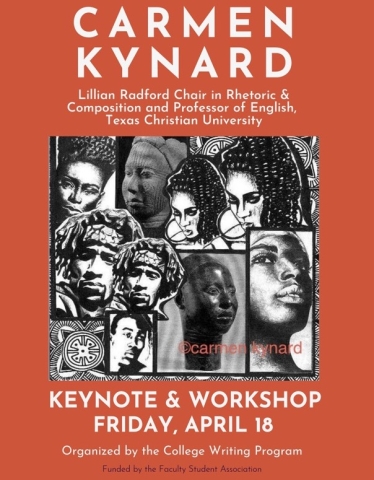
On April 18, 2025 the College Writing Program hosted Dr. Carmen Kynard. She gave a public keynote talk followed by a pedagogical workshop for faculty, staff, and graduate students exploring Black language and Black rhetorical practices. This event was generously funded by a grant from the Faculty Student Association.
In her public keynote--"'Mama Said Knock You Out': Lessons from Classrooms on the Black Radical Traditions of Refusal and Creative Escape"--Dr. Kynard traced Black fugitive practices--- past and present--- marking minoritized students as the most critical makers of anti-colonial schooling. She discussed the ways that institutions, administrators, policy makers, and faculty often imagine themselves as the sole inspiration for educational change and progressivism. However, her talk located the legacies and futures of Black Radical traditions with Black and Brown youth and their allies as the truthtellers, curriculum questioners, alt-linguistic models, multimodal artists, digital activists, literacy architects, creative designers, and transnational dreamers of education.
In Dr. Kynard's followup workshop--"Black language, Black Rhetoric, and the Radical Politics of Communication: Walk it Like I Talk it/Write it Like I Talk it"--she encouraged faculty, staff, and graduate students to examine and apply key tenets of Black Rhetorics and explore what those tenets mean for student writing and how we teach.
If you would like access to Dr. Kynard's workshop slides for integration into your own courses, simply contact Natalie Szymanski (szymanna@buffalostate.edu)
*image: event promotion poster with Dr. Kynard's art of various African American faces :"Carmen Kynard: Lillan Radford Chair in Rhetoric and Composition and Professor of English, Texas Christian University" Bottom text: "Keynote and Workshop, Friday, April 18. Organized by the College Writing Program"*
Linguistic Justice Talk and Workshop
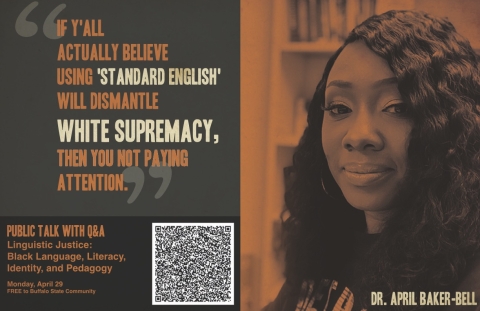
On April 29, 2024, the College Writing Program hosted Dr. April Baker-Bell. She gave a public keynote talk followed by a pedagogical workshop for faculty, staff, and graduate students exploring linguistic justice and Antiracist Black Language Pedagogy. This event was generously co-sponored by a number of interested departments, programs, and initiatives across campus (English Department; Teaching and Learning Center; Social Justice Center; Honors Program; Provost Office; Office of Equity and Diversity; and the School of Arts and Sciences).
In her keynote talk Dr. April Baker-Bell discussed how anti-Black linguistic racism and white linguistic supremacy gets normalized in teacher attitudes, curriculum and instruction, pedagogical approaches, disciplinary discourses, and research. She also discussed the impact these decisions have on Black students’ language education and their linguistic, racial, and intellectual identities. Finally Dr. Baker-Bell introduced a new way forward through Antiracist Black Language Pedagogy, a pedagogical approach that intentionally and unapologetically places Black Language at the center to critically interrogate white linguistic hegemony and anti-Black linguistic racism.
In her workshop, participants from across campus engaged in conversations and got practical advice on how they could implement Antiracist Language Pedagogies in their work. Campus members also had the opportunities to ask specific questions about their teaching philosophies of language, language policies, curriculum, practices, syllabi, writing assignments, etc. Dr. Baker-Bell left us with sample syllabi, assignments, and activities.
*image: event promotion poster with Baker-Bell face and quote :"If Y'all actually believe using 'Standard English' will dismantle White Supremacy, then you not paying attention." Bottom left text: "Public Talk and Q&A Linguistic Justice: Black Language, Literacy, Identity, and Pedagogy Monday, April 29. Free to Buffalo State Community"*
Following her visit, the teaching faculty in the College Writing Program continue to work through the "stations" in her resource materials:
PART 1: REFLECTING + RETHINKING
- Station 1: Radical Self-Work + Positionality + Teaching Philosophy of Language
- Station 2: Approach to Language/ Writing Pedagogy
- Station 3: Rethinking Language/ Writing Pedagogy
- Station 4: Creating Space for Linguistic Consciousness-Raising
PART 2: REIMAGINING + RETHINKING
- Station 5: Course Design | Redesign
- Station 6: Course Design | Redesign
If you would like access to Dr. Baker-Bell's workshop guide for integration into your own courses, simply contact Natalie Szymanski (szymanna@buffalostate.edu)